Navigating Intersections: Renter Expectations and Artificial Intelligence

At SatisFacts, we’re dedicated to understanding the ever-changing dynamics of renter expectations. Recently, we conducted focus groups with renters nationwide to explore the impact artificial intelligence (AI) has on their perception of customer service. Our findings illuminate the complex interplay between technology and human connection, offering valuable insights for multifamily operators seeking to enhance their residents’ living experiences.

From Science Fiction to Practical Applications

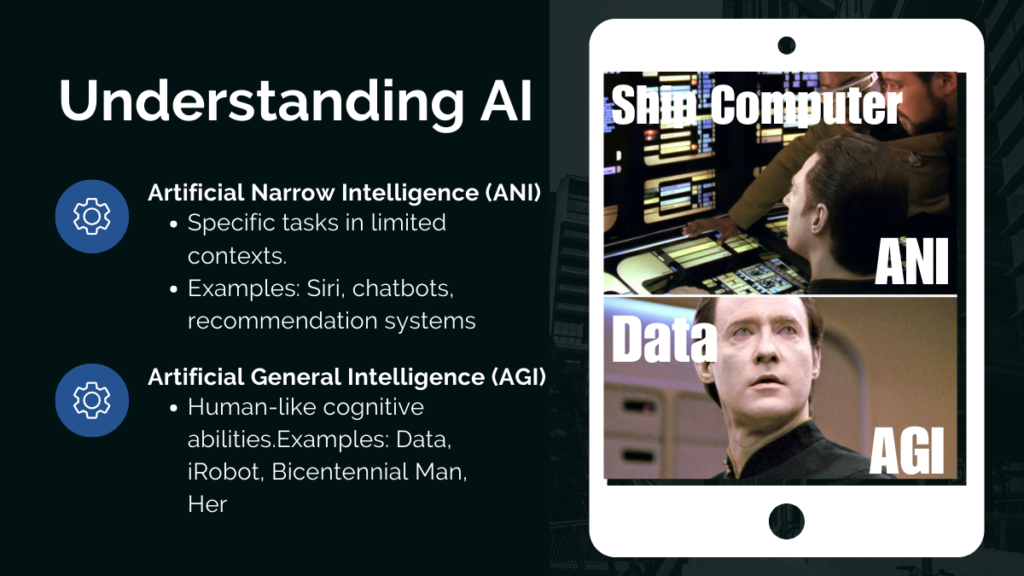
When thinking about artificial intelligence, popular culture often conjures images of human-like cognitive abilities akin to those seen in science fiction classics like Bicentennial Man or Star Trek. However, the reality of AI today is far more nuanced. Artificial narrow intelligence, which focuses on specific tasks within limited contexts, is becoming more prevalent in everyday applications such as Siri, chatbots, and recommendation systems. This distinction underscores AI’s practicality and tangible benefits in multifamily operations, moving us away from science fiction and into the reality of operational efficiency and enhanced resident and employee experiences.
The Role of AI in Multifamily Marketing

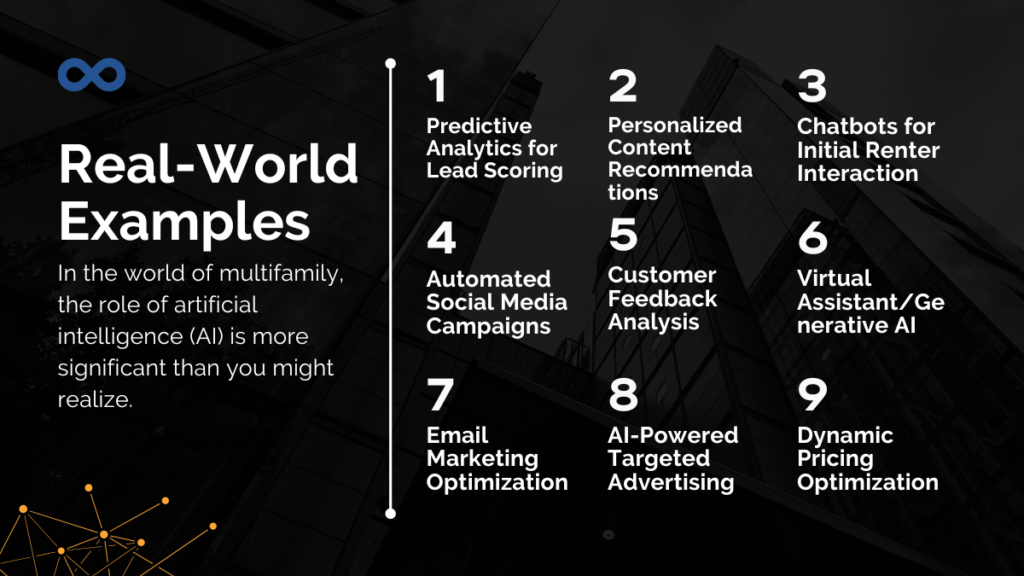
Today, artificial intelligence (AI) already plays a pivotal role in multifamily marketing across various applications. Predictive analytics and lead scoring are commonplace within customer relationship management (CRM) systems, enabling operators to forecast and prioritize leads effectively. Chatbots have become ubiquitous on multifamily websites, offering instant assistance and streamlining renter interactions. Moreover, content recommendation and personalization enhance engagement in email marketing campaigns, optimizing the delivery of relevant content to recipients. Paid marketing campaigns, including social media and Google ads, leverage automated systems to serve targeted audiences with higher-performing ads. However, dynamic pricing may be the most significant application of AI in multifamily. By utilizing algorithms to analyze multiple inputs, operators have optimized rental rates dynamically, ensuring competitive pricing and maximizing revenue potential.

What truly has multifamily executives buzzing with excitement today is the emergence of large language models (LLMs). These advanced AI systems possess the remarkable ability to understand and generate human-like text, offering multifamily operators a powerful tool for enhancing customer experiences. From answering queries and generating content to engaging in dialogue, LLMs represent a paradigm shift in how operators think about their approach to resident interactions and customer service.
Growing Public Concern

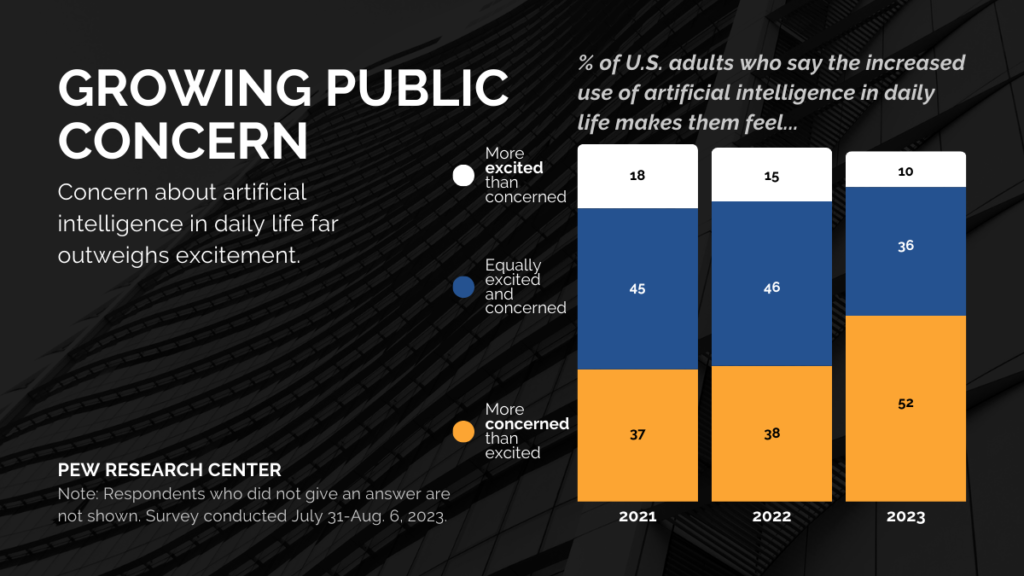
As multifamily operators venture into introducing AI solutions, it’s vital to acknowledge the growing public concern surrounding the increased use of AI in daily life. According to a recent Pew Research Center study, about half of Americans express more concern than excitement about this trend. This sentiment has seen a significant uptick, rising by 14 percentage points since last year to the current figure of 52%, up from 38% in December 2022.
Understanding this backdrop is crucial as operators embark on integrating AI into multifamily leasing workflows, particularly those interacting directly with renters. The goal is to elevate the renter experience, not substitute human connection. Applications must be tailored to renters’ needs, akin to a well-tailored suit. Our interviews with renters across the country echoed this sentiment, with many expressing a preference for human involvement in their leasing process. As one renter aptly put it, “Even though it’s a rental or a lease, I still want the human factor involved where I live so that there’s an actual person overseeing everything and that things are resolved with the human element to it.” Another renter voiced concern about the potential for fully AI-managed buildings, “I would be worried about signing a lease with a property management agency in a building where everything is AI self-served,” highlighting the importance of maintaining a balance between technology and human touch in multifamily operations.

AI In Customer Support

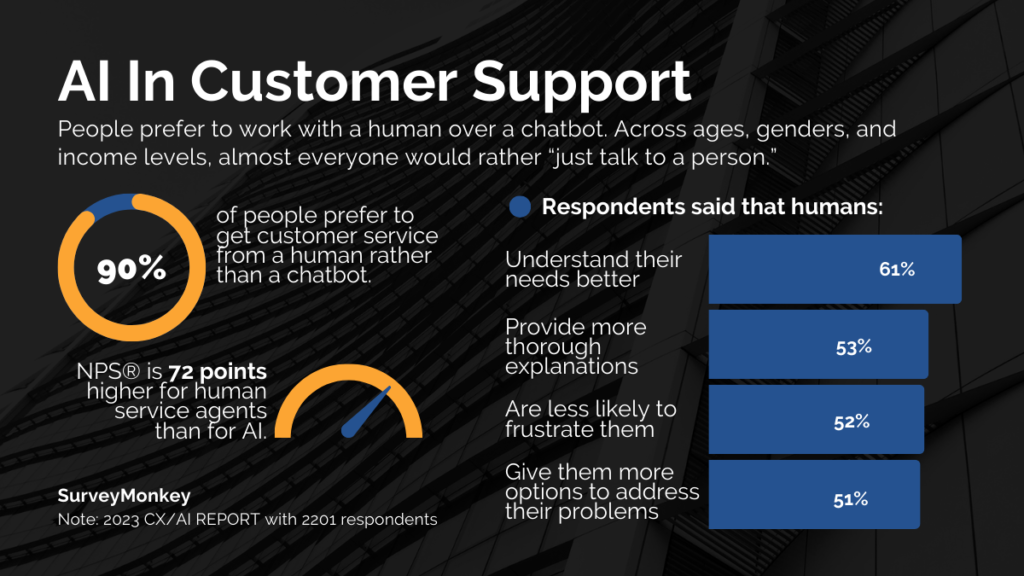
Our research also sheds light on renter preferences regarding customer service and interacting with AI versus human representatives. When analyzing consumer data from a survey conducted by SurveyMonkey on AI and customer service, a striking trend emerged: a resounding 90% of respondents expressed a preference for human customer service over chatbots or AI. Further examination of Net Promoter Scores (NPS) revealed a significant disparity, with NPS scores for human service agents surpassing those for AI by 72 points. Respondents cited various reasons for their preference for human interaction, including humans’ better understanding of their needs (61%), provision of more thorough explanations (53%), decreased likelihood of frustration (52%), and offering more options to address their problems (51%).
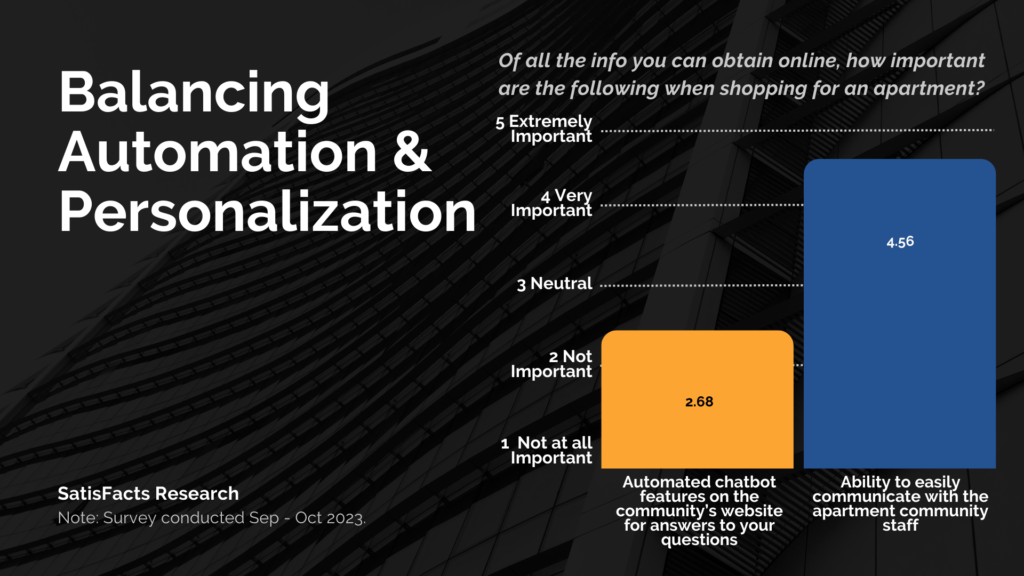
Our own research at SatisFacts corroborates these findings, with renters overwhelmingly leaning towards human customer service. As one renter said, “I always like to speak to a human…I just feel like it helps move things along quicker, and you get better service.” In our Biennial Online Renter Study, we also observed that renters rated the importance of automated chat significantly lower (2.68) than the ability to easily communicate with the apartment community staff (4.56), indicating a clear preference for human interaction.
One plausible explanation for this preference is the current limitations of the technology deployed on community websites today, which often fail to address even the most straightforward questions, such as breed restrictions. It’s evident that the human element remains integral to the renter experience, and while AI shows promise, its current limitations necessitate human intervention for addressing even simple queries and ensuring satisfactory resolution.

Leveraging AI for Enhanced Leasing Experiences

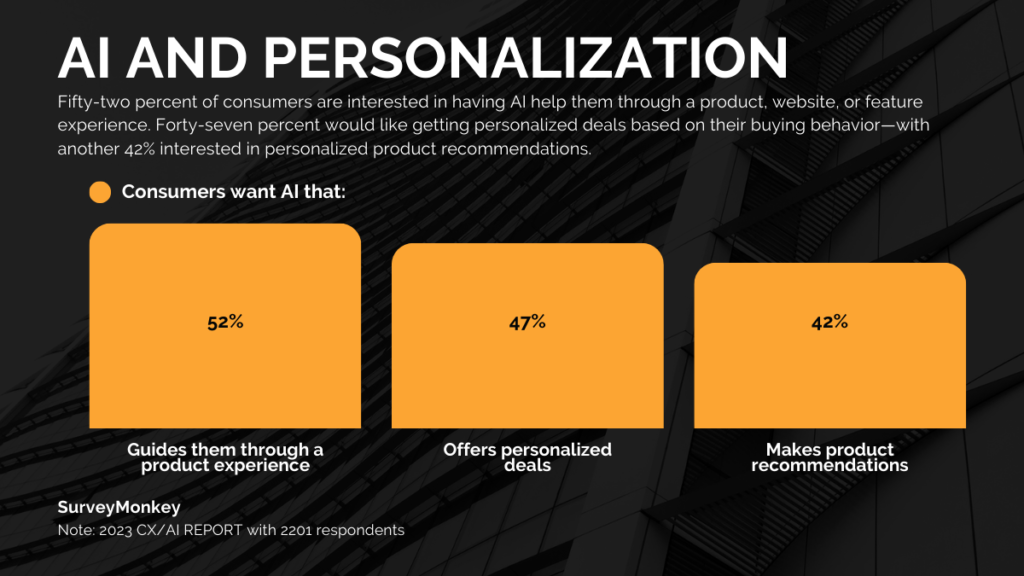
When inquiring about consumer perspectives on how AI could enhance their experience, respondents to the Survey Monkey study expressed interest in specific functionalities. Among respondents, 52% highlighted the desire for AI to guide them through product experiences, while 47% wished for personalized deals, and 42% sought AI-driven product recommendations.
Aligning with these consumer sentiments, our conversations with renters shed light on similar expectations regarding AI’s role in improving the leasing process. For instance, a 28-year-old female renter emphasized the potential for AI to address minor inquiries or requests that may not necessitate direct human interaction. Echoing this sentiment, another 31-year-old female renter envisioned AI expediting documentation processes and completing essential paperwork faster.

Responding to Online Reviews

While consumers and renters recognize AI’s potential to enhance certain aspects of their purchase and leasing journeys, it’s important to note that both groups remain wary of AI’s involvement in responding to online reviews. This insight underscores the delicate balance between leveraging AI for efficiency and preserving authentic human engagement, particularly in critical areas like reputation management.
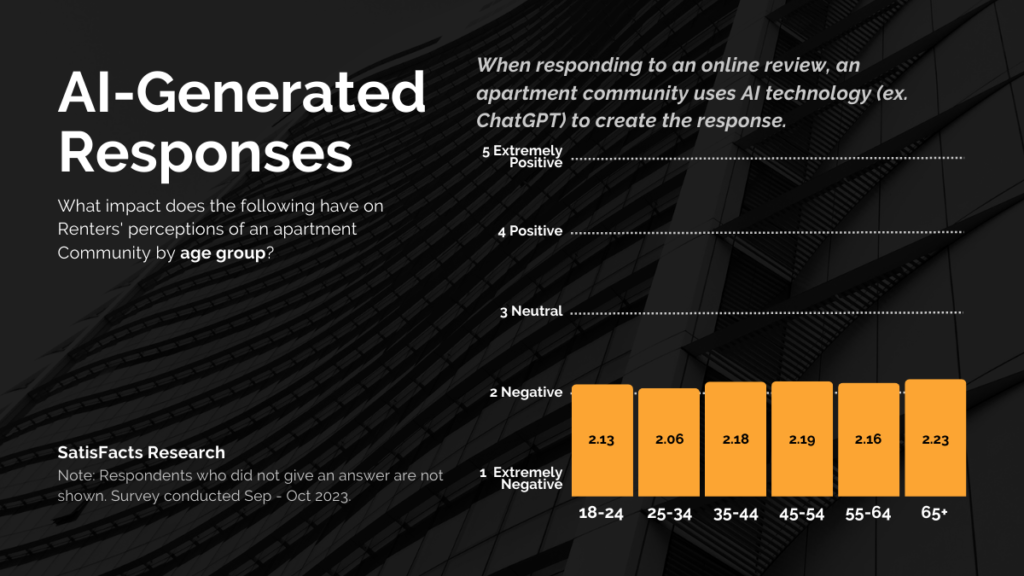
Our Biennial Online Renter Study looked into the impact of AI technology on renter perceptions of apartment communities when responding to online reviews. Across age groups, respondents expressed a clear aversion to AI-generated responses, with the sentiment rating dropping from 2.54 to 2.04 on a scale where neutrality sits at 3, indicating a negative perception, particularly among renters paying higher rents. Further insights from our focus group discussions shed light on the nuanced feelings toward AI in online review responses.
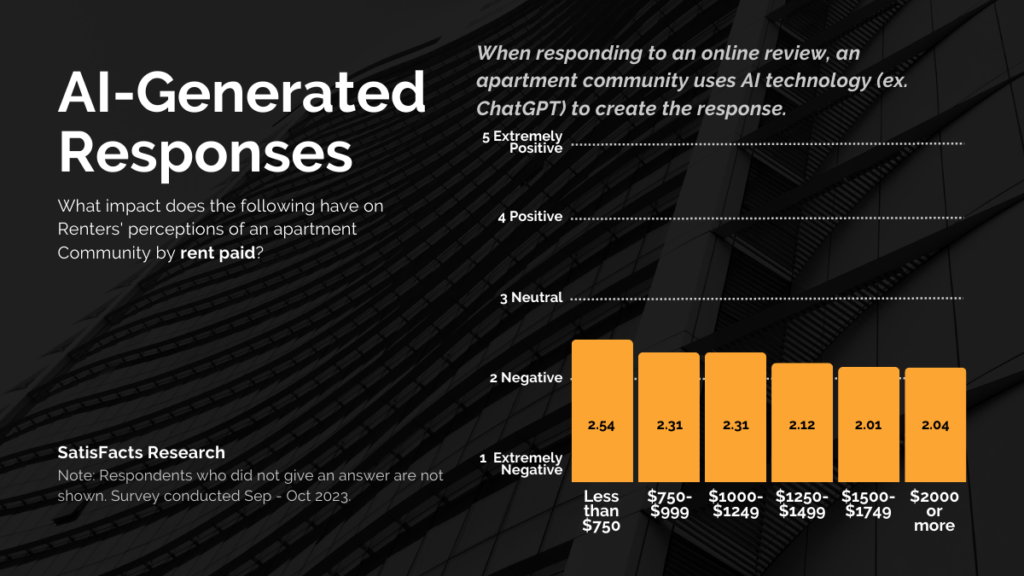
Comments from focus group participants highlighted concerns about feeling disheartened or perceiving AI responses as a copout. While some renters expressed skepticism about AI’s influence on their perception, they emphasized the importance of full transparency regarding AI involvement in crafting responses. This nuanced feedback underscores the delicate balance between leveraging AI for efficiency and maintaining authenticity in managing online reputation, highlighting the need for transparent communication to ensure renter trust and satisfaction.

Striking the Balance Between Innovation and Empathy

The integration of AI into multifamily operations represents a delicate balancing act. While AI offers undeniable benefits in terms of efficiency and automation, it must complement, rather than replace, the human touch that defines exceptional resident experiences. By prioritizing transparency, empathy, and collaboration, multifamily operators can navigate this intersection with confidence, ensuring that technology enhances, rather than diminishes, resident satisfaction.

At SatisFacts, we remain steadfast in our commitment to empowering multifamily operators with the research-backed knowledge and tools needed to navigate this evolving landscape successfully. If you want to learn more about how your residents feel about the technology you’ve implemented and its impact on resident and employee satisfaction, contact the SatisFacts & ApartmentRatings education team for a complimentary technology survey consultation.
Re-evaluating Review Practices: Enhancing Transparency and Trust in the Multifamily Industry

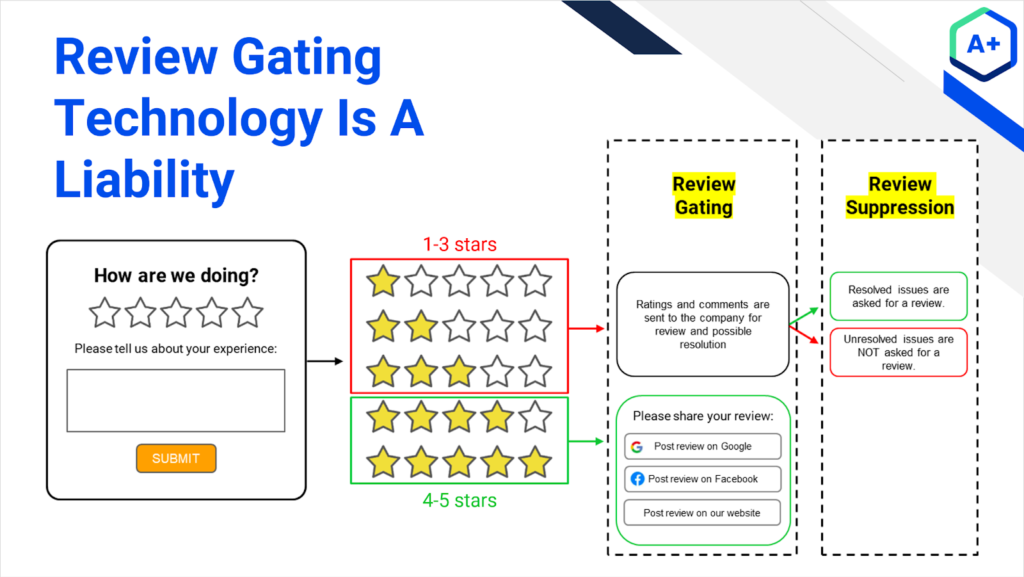
In today’s digital age, online reviews have become a vital source of information for individuals seeking an apartment. In fact, according to the most recent SatisFacts Biennial Online Renter Study, 76% of renters researched their community’s online reviews prior to making first contact. These reviews serve as a window into the experiences of current and former residents, providing prospective renters with valuable insights before making a housing decision. However, the unethical practice of review gating has emerged as a growing concern, distorting renters’ perceptions of service quality and fostering a disconnect between expectations and reality. This article sheds light on the math behind review gating, its negative implications, and the subsequent erosion of customer trust and satisfaction.

The Math Behind Review Gating

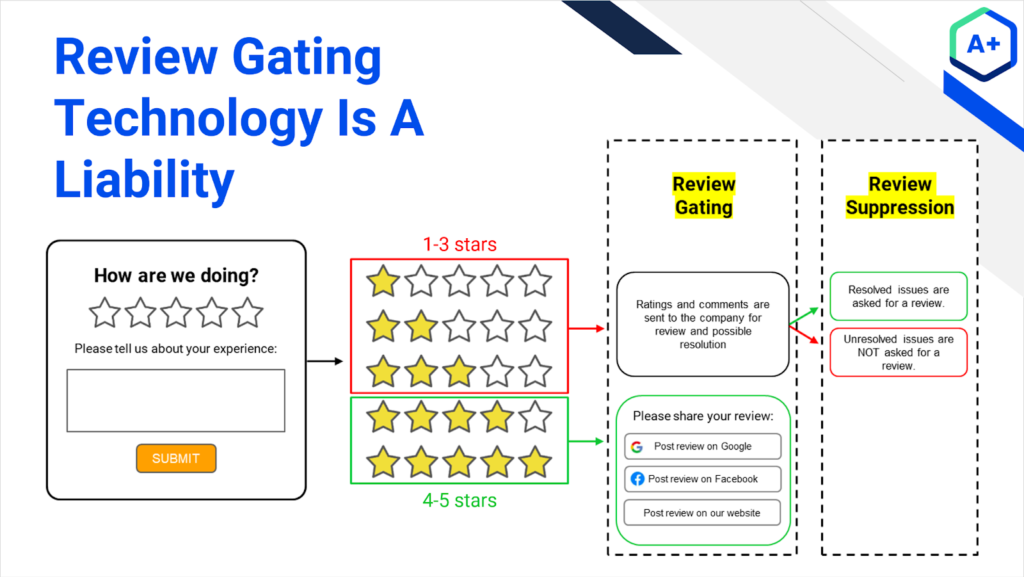
Today, many technologies and strategies are used to effectively gate or suppress select reviews from being shown online while promoting others. To understand the impact of review gating, let’s examine one possible scenario and its effect on consumers. Let us consider a community with 300 units, where 100 ratings and reviews were collected over six months.

  • 60 one-star ratings
  • 5 two-star ratings
  • 3 three-star ratings
  • 6 four-star ratings
  • 26 five-star ratings

In this scenario, review gating would selectively post only the positive ratings, 4 and 5-star scores, to online review sources (Google, Yelp, ApartmentRatings, etc.). On the other hand, the remaining lower ratings and any feedback provided are channeled internally, shielding them from public view.

The Outcome

Positive: 32 online reviews
Negative: 68 negative experiences invisible to prospective renters

Of the possible 100% of authentic reviews that could have been shared publicly, the practice of review gating, as provided by this example, only allows for 32% of their renters’ authentic voices to be shared.

It is important to note that these calculations are based on an illustration of how review gating can selectively control the visibility of reviews, skewing the overall perception of a community’s reputation.

Unveiling The Unethical Implications

Review gating, while seemingly innocuous on the surface, bears significant ethical concerns. By actively suppressing negative feedback, management companies engage in a disingenuous practice that misrepresents the true nature of their existing service level. This practice effectively creates a false-positive feedback loop, promoting an inflated and inaccurate perception of customer satisfaction.

The Chasm Between Expectations & Reality

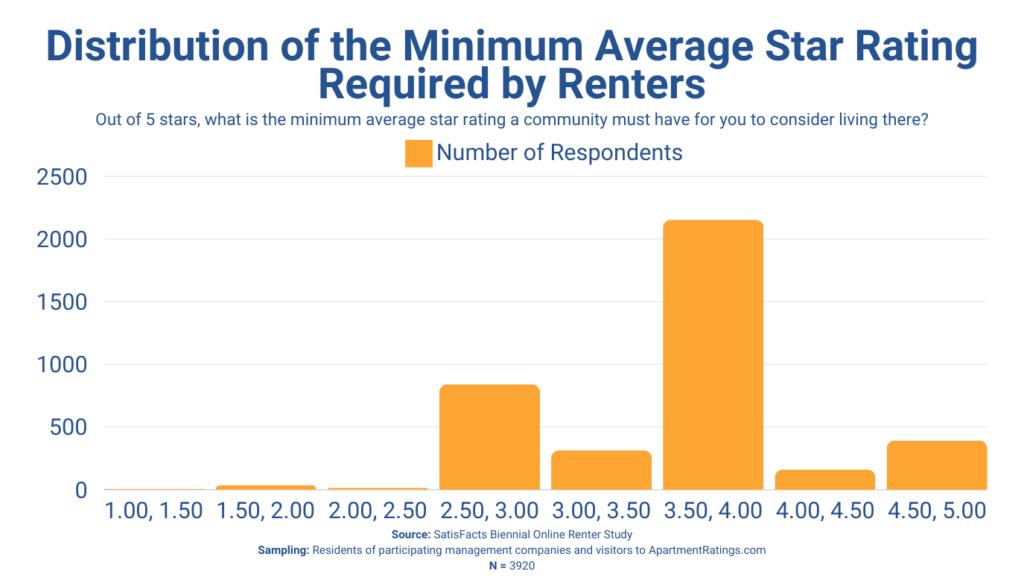
In the latest Online Renter Study, renters were asked about the minimum average star rating that would prompt them to consider living in an apartment community. The findings revealed an average star rating of 3.82, signaling the desire for a blend of positive feedback and constructive criticism and indicating that renters appreciate an authentic portrayal of the community’s strengths and weaknesses. They value transparency and authenticity in online reviews, actively seeking out both positive and negative feedback to gain a holistic understanding of the community.

The accompanying distribution table illustrates a concentrated range of minimum star ratings falling between 3.5 and 4.0. This concentration reflects a pragmatic approach by renters, valuing a comprehensive view that acknowledges both the positive attributes and areas for improvement within a community. It suggests that renters recognize no community is flawless and prioritize a balanced representation of resident experiences to inform their decisions.

For the minimal 15% of respondents seeking a four-star or higher rating, it is noteworthy to emphasize the importance of having the capacity to meet or exceed those higher standards to ensure resident satisfaction. When these expectations are not met with real-life experience, renters will be left dissatisfied.

Review gating leads to a disconnect between that expectation of service and the actual experience after moving into a community. Individuals are lured into renting apartments based on an incomplete and biased community representation. This discrepancy between expectations and reality can have profound consequences, including high resident turnover rates and decreased referrals. According to the SatisFacts Online Renter Study, referrals have dropped 20% over the last ten years.

When residents’ experiences do not align with the rosy picture painted by selectively displayed ratings and reviews, dissatisfaction and disappointment can quickly set in. Frustrated by unmet expectations, renters may decide to refrain from renewing their leases, exacerbating turnover rates within the community. In fact, it is not uncommon for the multifamily industry to witness residents citing inadequate service experiences as a primary reason for not renewing their leases.

Domino Effect of Review Gating

When review gating is employed, negative feedback is suppressed, creating a domino effect that has far-reaching consequences. This approach not only hides critical feedback from the public eye but also puts pressure on management companies to address a growing list of concerns raised by residents. When resident concerns are ignored or left unaddressed, it will likely have a significant negative impact in many areas throughout the organization: deterioration of trust and satisfaction from customers, employee disengagement, and management exposure to liability.

Creating a Disconnect

When negative feedback is suppressed through review gating, a disconnect is formed between residents and management. As negative reviews and feedback accumulate internally, overwhelmed site teams who may already be understaffed or lack support find themselves unable to effectively address the growing number of concerns. This leads to frustration and dissatisfaction among residents, exacerbating the disconnect and straining the relationship between both parties.

Impact on Employee Turnover

Suppressing negative feedback not only affects residents but also has a significant impact on the site team’s morale and employee turnover. Overwhelmed and unsupported site teams experience a decline in confidence and job satisfaction. Overwork and lack of engagement lead to decreased motivation and diminished ability to provide exceptional service. This further perpetuates the cycle of negative feedback.

Legal Consequences

The consequences of disregarding negative feedback go beyond resident dissatisfaction. Failure to address genuine concerns can result in investigations and other legal consequences for management. If concerns are left unresolved for extended periods, local authorities may intervene, increasing the liability faced by management. This highlights the potential legal ramifications that arise from suppressing authentic feedback and failing to address resident issues adequately.

In January 2022, the Federal Trade Commission (FTC) took action against review management platforms that engage in review gating practices. The FTC issued warnings to ten such platforms and imposed a fine of $4.2 million. This move signifies the FTC’s determination to crack down on brands and platforms that manipulate reviews.

Additionally, the FTC and several states filed a lawsuit against rental listing platform Roomster and its owners for deceiving prospective renters with fake reviews and fraudulent listings. As part of the legal action, a proposed order was filed, which would require a seller of fake reviews to pay $100,000 and cooperate in the case against Roomster.

The FTC continues to crack down on review gating and suppression with new proposed rules, highlighting regulatory bodies’ growing scrutiny and enforcement efforts to combat review manipulation and ensure the authenticity and reliability of consumer reviews. The FTC’s stance sends a strong message to companies and platforms that engage in deceptive practices related to online reviews (including apps that filter negative reviews on websites and intercept negative feedback), emphasizing the need for transparency, honesty, and fair practices in managing and presenting customer feedback.

Embrace Transparency & Build Trust

Review gating in the multifamily industry has significant ethical and financial implications and, if not closely monitored, can lead to a distorted perception of service quality and a disconnect between renters’ expectations and their actual experiences. By selectively suppressing negative feedback, management companies create false-positive feedback loops, misalign business objectives, increase liability, and hinder the needs of both customers and employees.

To address these challenges, management companies must adopt a different approach. Instead of relying solely on the latest review-gating technology, they should prioritize using a comprehensive survey program that allows operators to evaluate service levels internally. By collecting actionable data and feedback directly from customers (residents and employees), management gains valuable insights that inform improvement plans and facilitate quality service delivery.

Furthermore, promoting online reviews should be delayed until management companies are confident that they deliver adequate service and support to their renters. Systematically rushing to promote reviews without addressing underlying issues can lead to the negative consequences outlined above.

At SatisFacts and Apartment Ratings, we advocate for authenticity, trustworthiness, and a genuine online reputation. We provide tools to enhance service delivery, earning honest ratings and reviews. By utilizing organizational listening tools like Insite by SatisFacts and prioritizing transparency and integrity, management companies in the multifamily industry can simultaneously address residents’ concerns, identify areas for improvement, and establish a foundation of trust and satisfaction. This proactive approach provides a more accurate representation of service quality, enhances the renter experience, and fosters a positive reputation within the industry. By employing internal evaluation surveys, delaying the promotion of online reviews, and consistently delivering exceptional service, management companies can align their business objectives with meeting the needs of both renters and employees. This holistic approach builds trust, cultivates resident satisfaction, and ultimately contributes to long-term success.

Say no to review gating and yes to services like our surveys, education and reputation management platform. Build a reputation that withstands scrutiny, endears you to your employees and residents, and stands the test of time. After all, in the digital era, genuine connections and honest experiences are what resonate the most.

How Bigos Management Boosted Their Reputation with VRP

New data from the SatisFacts Online Renter Study shows ratings and reviews sites as a Top 3 source used by renters in researching apartments. Concurrently, it shows ratings and reviews as the #1 most trusted source when deciding whether or not to rent with an apartment community. In fact, over 73% of renters cited it as their most trusted source, beating referrals from friends, family and co-workers by 18%.

ApartmentRatings is the only renter-facing ratings and reviews site in the multifamily space. It is also the only review site with a built-in verified review program that automates reviews directly from verified renter feedback to ensure review transparency. Over 72% of renters say the most helpful element of an online review is that it’s from a verified resident who lives/has lived at the community. With authenticity playing a crucial role in how prospective renters perceive a community, the verified review program has helped both renters and operators alike, to ensure renters feel a sense of trust in the community(ies) they are researching on ApartmentRatings.

The leadership team at Bigos Management understands the vital role that an authentic online reputation plays in a prospective renter’s journey and the impact that review management and response can have on a renter’s decision to contact, and ultimately sign a lease with, an apartment community.

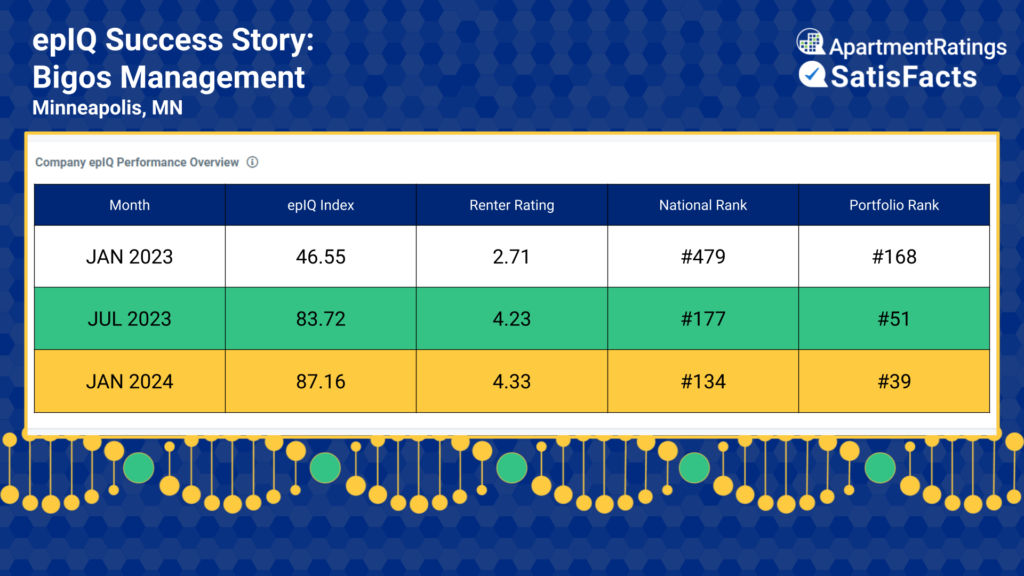
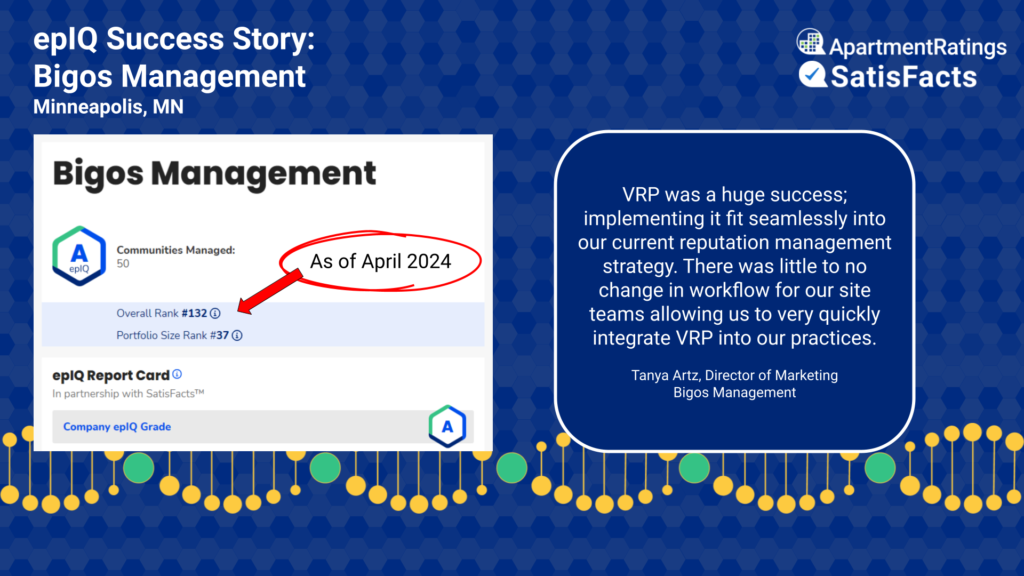
When Bigos Management implemented our verified review program into their reputation strategy, their epIQ Index saw a 34 point increase with a 775% increase in review volume in just 60 days. Six months post-implementation, their epIQ Index saw an 81% improvement, placing them at #51 in their portfolio size out of 300+ companies nationwide. Additionally, their review volume surged by 1,875%. As of January 2024 and as part of our annual awards season, Bigos was recognized as an epIQ Top 100 Management Company. And as of today, their communities’ renter ratings and review volume continue to improve month over month with 40% of Bigos communities currently ranking as the #1 community in their city.

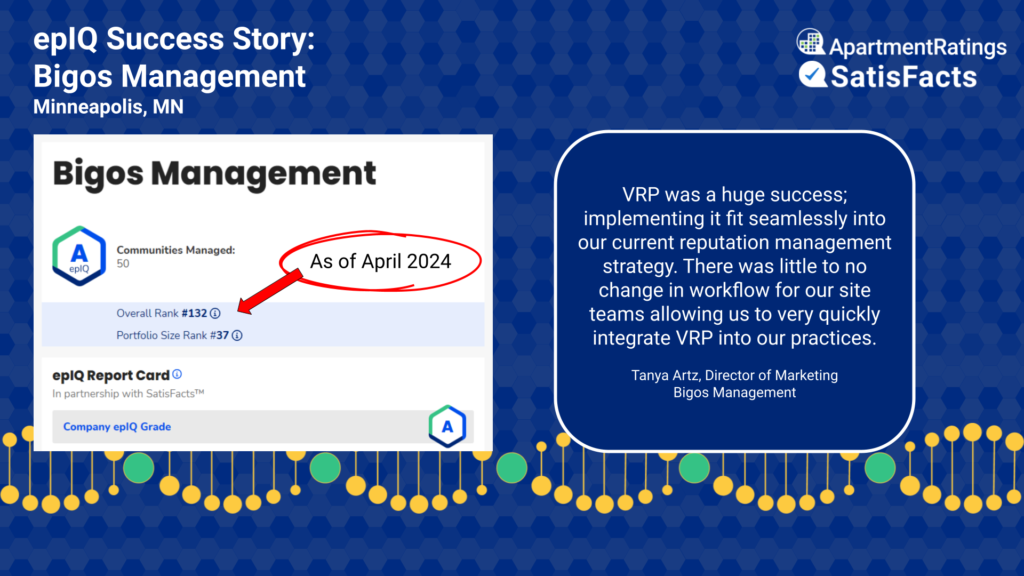
“VRP was a huge success. Implementing it fit seamlessly into our current reputation management strategy. There was little to no change in workflow for our site teams, allowing us to very quickly integrate VRP into our practices.”~Tanya Artz, Director of Marketing

See real results from Bigos Management’s implementation of VRP into their reputation management strategy and the effect the Verified Resident Program (VRP) has on boosting review generation and online reputation.

Looking for a survey, review cultivation, or review responder partner? Let us help you kick-start your journey.

Stepping Stones to Psychological Safety

Leveraging Anonymous Surveys

In our line of work, fostering an environment where every voice feels heard and valued is not just a goal—it’s a necessity. That’s why I’m a staunch advocate for the use of anonymous employee and resident surveys within our multifamily communities and operations. This practice is more than just a method of gathering data; it’s about creating a psychologically safe space where genuine, honest feedback can flourish.

Imagine the alternative: a scenario where our employees and residents hold back their true thoughts for fear of retaliation, perhaps stemming from past experiences. While this fear may often be misplaced, it’s crucial to acknowledge that perceptions of retaliation can still linger, influencing the unwillingness to speak up. This silence doesn’t just stifle individual voices; it buries potential issues and overlooks opportunities for growth and improvement. The essence of anonymity in our surveys isn’t merely a feature—it’s a cornerstone of fostering a culture that prizes psychological safety.

This focus on psychological safety is grounded in extensive organizational behavior and psychology research. It shows us that when people feel safe to express themselves—knowing they won’t face negative repercussions—they’re more likely to engage in open communication, innovate, and report errors. All of these actions are vital for the well-being and performance of our communities.

The parallel between anonymous surveys and psychologically safe environments is clear: both aim to dismantle the fear of speaking up. By ensuring responses cannot be traced back to individuals, we directly address the concern of retaliation, much like a psychologically safe environment does, by assuring people they won’t be punished or humiliated for their honesty.

However, our commitment must go beyond just anonymous surveys. Actual change requires us to build an overarching culture of trust and safety. Anonymity in feedback is a step in the right direction, but it’s only part of the solution. The more profound challenge lies in cultivating an environment where open expression is the norm, not the exception—where our team members and residents feel valued and heard at every turn.

We can help you take that first step and provide your team with the education and consulting they need every step after. Join other top-performing multifamily professionals who view SatisFacts not only as a tool for gathering feedback but as a stepping stone toward creating more inclusive, open, and psychologically safe communities.