Five Stars, Highly Suspect


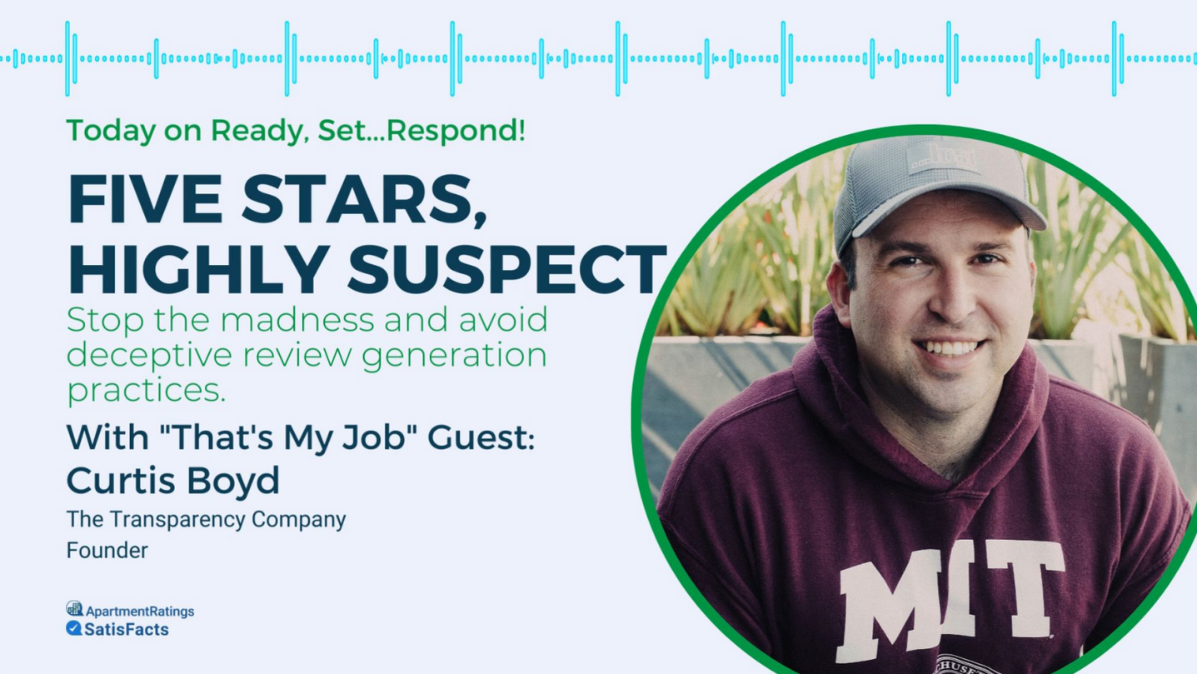
During the March 2023 episode of “Ready, Set…Respond!” we talked with Courts Boyd of The Transparency Company about the growing concern of fraudulent online reviews and their impact on consumers and businesses. The rise of online reviews has transformed the way consumers and renters make decisions. Many people now rely heavily on online feedback and ratings to determine whether they should buy a product, use a service, and even where to rent an apartment. In fact, according to SatisFacts’ most recent Biennial Online Renter Study, 79% of participants researched their current apartment’s online reviews before contacting the community directly. While online reviews can be a valuable tool, it is important to be aware of the potential for fraud and manipulation. In this article, we will cover:

  • The Growth of Fraudulent Online Reviews
  • Organizations That Monitor the Trustworthiness of Online Reviews
  • Ethical Online Review Cultivation Best Practices 

The Growth of Fraudulent Online Reviews

As the use of online reviews has grown, so has the problem of fraudulent reviews. These are reviews that are posted by people who have not actually used the product or service they are reviewing or who have been paid to write a positive review. The practice of posting fake reviews is sometimes called “astroturfing,” and it has become a major issue for consumers, businesses, and regulators alike.

One reason why fraudulent reviews have become so prevalent is that they can be very profitable for businesses. Positive reviews can help a company attract new customers and improve its search engine rankings, which can lead to more website traffic. In some cases, businesses have even hired third-party companies to post fake reviews on their behalf.

The problem is not limited to fake positive reviews, however. Some businesses have also been known to post negative reviews of their competitors in an effort to damage their reputation and gain a competitive advantage. This is known as “review bombing” and can have serious consequences for the targeted business.

The problem has grown so large that Google announced it developed a machine learning algorithm that can identify and remove fake reviews from its platform with greater accuracy. While Google has not released specific figures on the number of fake reviews it has removed, it did state in a recent blog post that it took down 3 million fake business profiles and 90 million policy-violating reviews in 2020.

Regulators have taken notice of the problem and have started to crack down on fake reviews. In the United States, the Federal Trade Commission (FTC) has issued guidelines for businesses and marketers on how to ensure that online reviews are truthful and not misleading. In addition, some states have passed laws that make it illegal to post fake reviews or engage in other forms of review manipulation, such as:

  • Fake reviews: These include reviews and endorsements by people who do not exist or have not used the product or service, or who lie about their experiences.
  • Review reuse fraud: Some sellers hijack or repurpose reviews posted about another product or service.
  • Paid reviews: Marketers may pay for positive reviews about their products or negative reviews about competitors’ products.
  • Insider reviews: These include reviews written by a company’s executives or solicited from its employees that don’t mention their connections to the company.
  • Review suppression: Companies might claim that their websites display all reviews submitted by customers when they suppress negative reviews or attempt to suppress reviews on other platforms by threatening the reviewers or use a 3rd party service to hide or filter out negative reviews.
  • Fake review websites: This is when a seller sets up a purportedly independent website or organization to review or endorse its own products.
  • Buying followers: This involves buying or selling followers, subscribers, views, or other indicators of social media influence.

Organizations That Monitor the Trustworthiness of Online Reviews 

As consumers become more aware of online review fraud and its pervasiveness, they are taking steps to protect themselves from fake reviews. One way is by looking for patterns in the reviews – for example if all the positive reviews were posted within a short period of time or if they use similar language, this could be a red flag. Consumers are also looking for reviews from verified accounts or trusted sources, such as independent review sites and organizations that monitor the trustworthiness of online reviews, such as:

  1. Consumer watchdog organizations: These are independent organizations that test and evaluate products and services, and often include information about online reviews in their evaluations.
  2. Online review monitoring companies: These companies use specialized software to track and analyze online reviews, looking for patterns or anomalies that may indicate fraud or manipulation. For example, The Transparency Company uses machine learning to identify fake reviews on Google Maps to help consumers find higher-quality businesses.
  3. Regulatory bodies: In some countries, there are regulatory bodies that oversee online reviews and monitor for fraud or deceptive practices. For example, in the United States, the Federal Trade Commission (FTC) has issued guidelines for businesses and marketers on how to ensure that online reviews are truthful and not misleading.
  4. E-commerce platforms: Many e-commerce platforms, such as Yelp and Apartment Ratings, have their own internal departments dedicated to monitoring and verifying online reviews on their platform. 

While the specific names of the departments or organizations that monitor online review trustworthiness may vary depending on the industry and location, they all share a common goal of ensuring that consumers have access to accurate and reliable information. 

Ethical Online Review Cultivation Best Practices 

Companies have a responsibility to ensure that they are cultivating online reviews ethically. Here are some ways that a company can fulfill this responsibility:

  • Encourage honest and unbiased reviews: Companies should encourage their customers to leave honest and unbiased reviews of their products or services. This means not offering incentives for positive reviews or punishing customers who leave negative reviews.
  • Disclose any relationships: If a company offers incentives or compensation for reviews, it should disclose this information clearly and prominently. This can help customers understand the context of the review and make a more informed decision.
  • Monitor for fake reviews: Companies should actively monitor their online activity for signs of fake or fraudulent reviews. This can involve using software tools or manually reviewing them to look for patterns or inconsistencies.
  • Respond to reviews appropriately: Companies should respond to reviews in a professional and respectful manner, whether the review is positive or negative. Responding to reviews can also demonstrate to customers that the company is engaged and responsive to their feedback.
  • Comply with regulations: Companies should comply with any regulations or guidelines related to online reviews, such as the FTC’s guidelines in the United States. This can help ensure the company is not engaging in deceptive or misleading practices.

Overall, a company’s responsibility to ensure it is cultivating online reviews ethically involves transparency, honesty, and a commitment to providing customers with accurate and reliable information. By following these principles, companies can build trust with their customers and maintain a positive reputation online.

Visit the Webinars tab to listen to the Five Stars, Highly Suspect webinar.
Dealing With Difficult People

As a residential property manager, dealing with difficult people can be a challenging and stressful part of your job. Whether it’s a resident who constantly complains or a property owner who is demanding and unreasonable, navigating difficult personalities requires a delicate balance of diplomacy, assertiveness, and patience. Failure to effectively manage difficult people can lead to conflicts, unhappy residents, and potential legal issues. In this article, we will explore practical strategies for dealing with difficult people in the residential property management profession, including identifying personality traits of difficult people, developing communication skills, and self-reflection. With the right tools and mindset, you can successfully navigate challenging situations and maintain positive relationships with all parties involved.

  • Identifying the seven personality traits of difficult people
  • Developing communication skills
  • Self-Reflection

Identifying the seven personality traits of difficult people

When preparing for the first episode of Ready, Set…Respond: “Make Love Not War – True and tested advice for responding to difficult people, I did a little digging to see what research was available on identifying what makes a person difficult. Most published research focused on extreme personality disorders, but being difficult isn’t necessarily a severe disorder. In fact, being difficult can be a temporary condition we all suffer from every once in a while, in varying degrees of intensity, which is precisely what Dr. Chelsea Sleep and a team of researchers out of the University of Georgia discovered. They now believe they can scientifically quantify the seven elements that make a person difficult. Those elements are:  

  1. Callousness: Lacking empathy or concern for others.
  2. Grandiosity: Feeling that one is better than other people.
  3. Aggressiveness: Being hostile and rude toward others.
  4. Suspiciousness: Feeling strong and unreasonable distrust of others.
  5. Manipulation: Exploiting others to benefit oneself.
  6. Domineering: Desire for authority over others and a sense of combativeness.
  7. Risk-taking: Looking for ways to experience thrills through risky behavior.

Knowing these seven traits can be extremely helpful when dealing with challenging individuals in any context, including residential property management. By understanding these traits, property managers can better recognize difficult personalities and develop effective strategies to manage them.

For example, if a resident displays aggressive behavior, a property manager can approach them calmly, speak in a non-confrontational manner, and listen actively to their concerns. If a property owner exhibits grandiose tendencies, a manager can acknowledge their feelings of importance while gently redirecting their focus to the issue at hand.

Developing communication skills

When addressing difficult people, it is essential to start with respect, practice active listening, communicate next steps, and follow up.

Start with respect: When dealing with difficult people, starting the conversation with respect is imperative. This means being polite and courteous, even if the other person is not. It also means acknowledging their perspectives and feelings, even if you disagree. Starting the conversation with respect sets a positive tone and can help de-escalate any tension.

Practice active listening: Active listening involves fully focusing on the person speaking and seeking to understand their perspective without interrupting or judging. When dealing with difficult people, it is especially important to listen actively, as it can help to diffuse their anger or frustration. Additionally, active listening can help identify the root cause of the problem, which can then be addressed constructively.

Communicate next steps: After actively listening and understanding the other person’s perspective, it is important to communicate next steps. This involves verbalizing the steps that will be taken to address the issue and setting realistic expectations for what can be achieved. It is also important to be clear about what actions the other person needs to take, if any, to resolve the issue.

Follow up: Following up is an important part of managing difficult people. It involves checking in with the other person to ensure that the issue has been resolved to their satisfaction and to address any outstanding concerns or issues. It is important to follow up promptly, as this demonstrates a commitment to resolving the issue, and can help build trust.

By starting with respect, practicing active listening, communicating next steps, and following up, property managers can effectively manage difficult people and resolve conflicts in a constructive manner. These strategies can help to maintain positive relationships with residents and property owners and create a more harmonious living environment for all involved.

Self-Reflection

Any time we go as far as to judge others, it’s always a best practice to turn that mirror around and take a close look at ourselves. In the spirit of self-reflection, knowing if you are a difficult person can also be beneficial. Firstly, self-reflection can help you identify your behavior patterns, including any traits that may contribute to difficult interactions with others. By acknowledging and addressing these patterns, you can work towards improving your interpersonal skills and avoid potential conflicts.

Secondly, acknowledging and working on your own difficult tendencies can help you become more effective at managing difficult personalities in others. By understanding your strengths and limitations, you can approach difficult situations more confidently and assertively while maintaining a collaborative and respectful tone.

Our friends over at IDR labs created a free 35-question test based on Sleep’s research that aims to score you on the seven traits that underpin antagonism and give you an idea of how hard it is for others to get along with you. Often, we may find that those around us are simply reacting to our behavior, and close self-evolution can only lead to discovery and personal growth. Take the self-assessment and feel free to share your results!

Visit the Webinars tab to listen to the Dealing With Difficult People webinar.

5 Realities of Review Generation in Multifamily

Review generation is a persistent challenge in the multifamily industry. It can be intimidating, time-consuming, and sometimes leads companies into looking for a “quick fix.” But in this day and age, businesses are under heavy scrutiny due to the Federal Trade Commission (FTC) creating more strict regulations, and the customer expectation being higher than ever. Bottom line, a “quick fix” won’t cut it. Don’t get caught up in a fake reputation that has renters looking elsewhere – keep it real.

Here are 5 misleading review generation practices and the reality about why you should avoid them:

  1. Hosting a review party or setting up a station during community events so residents can write a review.
    • Review site authenticators (bots) will consider a large influx of reviews in a short amount of time as spam and are likely to block the content and/or temporarily ban your company/community on the site. 
    • If a resident is writing a review in front of your team or in a public setting where other employees or residents can see it, they may feel forced or obligated to share a less-than-authentic review, which is not fair to them or to other renters interested in learning about the true resident experience in your community. This could potentially jeopardize the resident’s renewal decision as well.

Best Practice: Maintain a steady influx of reviews through authentic touchpoints, regular follow ups, and engagement with prospects and residents. 

  1. Asking for a negative review to be removed once the issue has been resolved.
    • This is against review best practices for review sites and could be considered a questionable legal threat. If a reviewer feels that they may be penalized for their review or not removing a negative review, this could be considered intimidation.
    • The resident may question the sincerity of your customer service if they feel any quid pro quo about an issue being fixed in exchange for removal of a review OR they may get the idea that when they have an issue, the best way to get it resolved is to write a negative review, which can create a cycle that no onsite team wants to deal with.

Best Practice: Most review sites have the ability to edit and/or add a thread update to a review. Using this practice not only provides an authentic representation of your resident experience, it also highlights your customer service, showing how your team reacts to issues and shines a light on their exceptional service.

  1. Encouraging residents to write about something specific regarding the community.
    • This puts each resident’s experience in a silo. Prospects read an average of 5 reviews before deciding to contact a community. If multiple renters write reviews mentioning a specific employee or a resident event and the prospect isn’t able to get an accurate sense of what the community is really like, they are more likely to continue their apartment search elsewhere.
    • Renters value review quality, not review quantity. Most review sites require a minimum length of text with their rating to better ensure the quality of reviews and to avoid review extortion schemes.

Best Practice: Encourage well-rounded reviews. A new move-in may not have as much knowledge of the community, but they can share what they have seen so far (and on most review platforms, they can continue to add onto their review down the road). A long-time resident has tons to share about why they chose to stay – all you have to do is ask. In the most recent Biennial Online Renter Study by SatisFacts, 71.6% of renters said they have never been asked to write a review. 60.4% of renters said they would write a review if asked.

  1. Gamification or offering reward points or other gifts is not considered a review incentive.
    • Per the FTC, incentives include anything given in exchange for a review; whether the review is positive or negative.
    • When review incentives of any kind are not disclosed either by the reviewer or in the review response, the management company can be penalized for violating the FTC Act.

Best Practice: Do not offer any incentive or motivation that may, intentionally or unintentionally, encourage a resident to write a review about a person or community. This practice will help ensure you do not get flagged and/or fined for incentivized reviews or review gating.

  1. Capture negative experiences internally before they become online reviews.
    • This can be considered review suppression, which is a violation of the FTC Act.
    • A third party that filters out negative reviews or offers a different path to negative feedback vs positive is practicing review gating. Several companies have been fined for this by the FTC as they continue to crack down across the multifamily industry.

Best Practice: Do not use any tools, service providers, or even internal communication that allows or suggests having negative feedback receive a different action or treatment than positive. All requests for feedback should be communicated equally and processed equally and should never be requested to be shared as a positive or favorable opinion.

In summary: Create a consistent touchpoint process and actively and genuinely engage with residents to create authentic review generation opportunities that reduce the intimidation factor and make asking for reviews second nature. According to a recent Yelp article, when reviewers feel they’ve spotted fake or untrustworthy reviews, 49% will go find other reviews to gather additional opinions, 34% won’t acknowledge the review in their process, 24% go look at another business, and 24% report the review to its respective platform. Whether losing a potential lease or paying a major fine and permanently damaging your reputation, not knowing the facts about review generation can be dangerous. 

If you’re unsure how to start building your touchpoint process, are ready to start generating more reviews authentically across multiple review platforms, or need help responding to your reviews, reach out to your dedicated account manager to get started!

Visit the Webinars tab to listen to the 5 Realities of Review Generation webinar.